


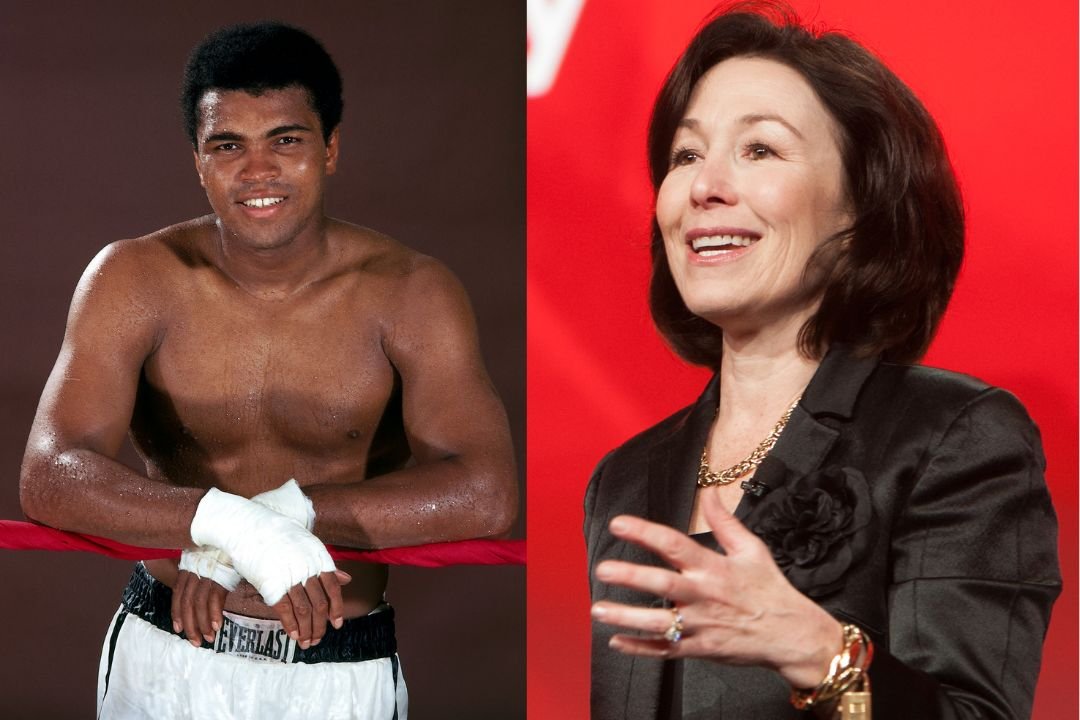
Muhammad Ali and Safra Catz are two prominent figures whose careers belong to very different worlds. Ali became one of the most famous boxers in history and later a major cultural and humanitarian figure. Catz built her career in finance and technology, eventually leading Oracle for more than a decade.
Despite their names appearing together in online searches, there is no reliable public evidence establishing that Muhammad Ali and Safra Catz were relatives, business partners, colleagues, or close personal associates.
Their lives did overlap chronologically. Ali lived from 1942 to 2016, while Catz built much of her corporate career during the later decades of his life. But simply being prominent figures during the same period does not establish a relationship.
Understanding the two separately provides a much clearer answer to why their names should not be connected without evidence.
Muhammad Ali and Safra Catz at a Glance
Muhammad Ali was an American professional boxer, three-time world heavyweight champion, activist and humanitarian. Born Cassius Marcellus Clay Jr. in Louisville, Kentucky, he became an Olympic gold medalist before establishing himself as one of boxing’s defining figures.
Safra Catz is a business executive best known for her long career at Oracle. She joined Oracle in 1999, became one of its CEOs in 2014 and served as CEO until September 2025. She now serves as Executive Vice Chair of Oracle’s Board of Directors.
Their professional paths were fundamentally different: Ali’s centered on sports, public advocacy and humanitarian work, while Catz’s centered on finance, corporate management and enterprise technology.
Are Muhammad Ali and Safra Catz Related?
There is no reliable public evidence that Muhammad Ali and Safra Catz were related.
Authoritative accounts of Ali’s family and career do not identify Catz as a relative. Likewise, Oracle’s official biography of Catz does not establish a family relationship with Muhammad Ali.
That distinction matters because repeated online association can easily create the impression that two public figures share a hidden family connection.
In this case, there is no credible basis for making that claim.
Ali and Catz came from different family backgrounds and developed careers in completely different industries.
Did Muhammad Ali and Safra Catz Work Together?
No documented professional collaboration between Muhammad Ali and Safra Catz was found in the reliable sources reviewed for this article.
Ali’s professional life revolved primarily around boxing, public speaking, activism, philanthropy and humanitarian causes.
Catz’s career developed through investment banking and corporate technology leadership, particularly at Oracle.
There is no established evidence that Catz managed Ali, represented his business interests, participated in his boxing career or worked with organizations associated with his legacy.
Likewise, Ali is not part of the professional history presented in Oracle’s official biography of Catz.
It is therefore more accurate to describe them as two prominent figures with separate careers than to imply a collaboration that cannot be documented.
Did Muhammad Ali and Safra Catz Know Each Other?
There is not enough reliable public evidence to state that Muhammad Ali and Safra Catz had a meaningful personal relationship.
That does not prove that they never met.
Public figures can attend the same events, meet privately or encounter one another without leaving a substantial public record. However, possibility is different from evidence.
Without a reliable interview, photograph with appropriate context, organizational record, biography or other credible documentation establishing a relationship, it would be speculative to claim that Ali and Catz were friends or close acquaintances.
For a trustworthy biography, that distinction should remain clear.
Who Was Muhammad Ali?
Muhammad Ali was an American boxer and cultural figure whose influence extended far beyond professional sports.
He was born Cassius Marcellus Clay Jr. on January 17, 1942, in Louisville, Kentucky.
His boxing ability became apparent early.
At just 18 years old, Clay won a light-heavyweight gold medal at the 1960 Olympic Games in Rome. He then turned professional and quickly developed a reputation for unusual speed, movement, confidence and an ability to promote his fights with memorable predictions and rhymes.
His personality made him impossible to ignore.
But athletic talent turned that attention into something much larger.
Muhammad Ali Became Heavyweight Champion
Ali’s first world heavyweight championship came in 1964 when he defeated Sonny Liston.
The result was one of boxing’s landmark upsets.
Ali was young, outspoken and extraordinarily confident, while Liston was an intimidating reigning champion. Ali’s victory transformed him into one of the biggest personalities in American sports.
His career subsequently included famous rivalries and fights against opponents such as Joe Frazier, George Foreman and Ken Norton.
Ali ultimately became a three-time world heavyweight champion.
Yet championship belts explain only part of why his name remained globally recognizable long after his final fight.
Why Did Cassius Clay Become Muhammad Ali?
Shortly after becoming heavyweight champion, Cassius Clay publicly embraced Islam and became known as Muhammad Ali.
The name change represented something far deeper than branding.
Ali’s religious beliefs became part of his public identity during a period of enormous social and political change in the United States.
His willingness to express his beliefs publicly also contributed to some of the most controversial moments of his career.
The most consequential came during the Vietnam War.
Muhammad Ali and the Vietnam War
Ali refused induction into the U.S. military during the Vietnam War, citing his religious beliefs.
The decision came with enormous professional consequences.
He was convicted of draft evasion, stripped of his heavyweight title and prevented from boxing during years that would normally have represented the physical prime of a professional athlete.
Ali continued challenging his conviction.
In 1971, the U.S. Supreme Court unanimously reversed it.
By then, his public identity had changed significantly.
Ali was no longer simply a boxer who generated attention with bold predictions. He had become part of much larger American conversations about religion, race, war, individual conscience and political dissent.
Muhammad Ali’s Greatest Fights
Ali returned to boxing and participated in several contests that became part of sports history.
His rivalry with Joe Frazier produced three fights, including the 1975 Thrilla in Manila.
Another defining moment came against George Foreman in 1974.
The fight in Kinshasa, Zaire—now the Democratic Republic of the Congo—became known as the Rumble in the Jungle.
Foreman entered as the younger and exceptionally powerful heavyweight champion.
Ali used a strategy that became associated with the phrase “rope-a-dope,” allowing Foreman to expend energy before Ali eventually stopped him in the eighth round.
The victory restored Ali to the heavyweight championship and became one of the most celebrated performances of his career.
Muhammad Ali Beyond Boxing
Ali’s influence continued after his boxing career ended.
He became increasingly associated with humanitarian work, diplomacy and charitable causes.
His public appearances carried a different meaning as his health declined.
Ali had been diagnosed with Parkinson’s syndrome, and the condition increasingly affected his movement and speech. Yet he remained an internationally recognized public figure.
One of the most memorable moments of his later life came during the 1996 Atlanta Olympic Games, when Ali lit the Olympic cauldron.
The appearance connected the young athlete who had won Olympic gold in 1960 with the global figure he had become decades later.
Muhammad Ali died on June 3, 2016, at the age of 74.
His influence continues through boxing history, popular culture and institutions preserving his humanitarian legacy.
Who Is Safra Catz?
Safra Catz is an Israeli-American business executive best known for her leadership at Oracle, one of the world’s major enterprise technology companies.
Her path to prominence was almost the opposite of Ali’s.
Ali became famous while still very young and spent much of his adult life under intense public attention.
Catz developed her reputation primarily within finance and corporate management.
Before joining Oracle, she held several positions at investment bank Donaldson, Lufkin & Jenrette, including Managing Director in Investment Banking.
She joined Oracle in 1999.
That decision would define the next several decades of her career.
Safra Catz’s Rise at Oracle
Catz advanced through a succession of senior leadership positions at Oracle.
Her roles included President, Chief Financial Officer, Executive Vice President and Senior Vice President.
She also joined Oracle’s Board of Directors in 2001.
Her background in finance became particularly important as Oracle pursued an aggressive acquisition strategy and expanded its business beyond its traditional database-software foundation.
Catz eventually became one of the company’s most important executives.
Then, in 2014, Oracle underwent a major leadership transition.
When Did Safra Catz Become Oracle CEO?
Safra Catz became an Oracle CEO in September 2014.
Oracle founder Larry Ellison stepped down from the CEO position and became Executive Chairman and Chief Technology Officer.
Oracle appointed Safra Catz and Mark Hurd as CEOs.
Their responsibilities were divided across different areas of the business. Catz’s responsibilities included manufacturing, finance and legal functions, while Hurd oversaw other major operational areas.
Catz later became Oracle’s sole CEO following Hurd’s departure.
Her leadership tenure coincided with a period in which Oracle increasingly shifted toward cloud computing and later positioned its infrastructure for the rapidly expanding artificial-intelligence market.
Is Safra Catz Still Oracle’s CEO?
No. Safra Catz is no longer CEO of Oracle.
This is an important update because older biographies and search results can still describe her as the company’s chief executive.
On September 22, 2025, Oracle announced that Clay Magouyrk and Mike Sicilia would become its CEOs.
Catz moved into the position of Executive Vice Chair of the Oracle Board of Directors.
Oracle’s current executive biography continues to identify her in that role.
Her transition did not mean completely leaving Oracle.
As Executive Vice Chair, Catz remains part of the company’s senior leadership structure and continues to bring decades of institutional knowledge to Oracle.
Safra Catz’s Career Before Oracle
Catz had already developed substantial financial experience before joining Oracle.
She worked at Donaldson, Lufkin & Jenrette, where her positions included Managing Director in Investment Banking.
That background helps explain her later role within Oracle.
Technology companies are often discussed primarily in terms of engineers, software products and innovation. But large technology corporations also depend on financial management, acquisitions, legal structures, capital allocation and operational strategy.
Catz built much of her reputation in those areas.
She later served on major corporate boards outside Oracle as well, including the boards of HSBC Holdings and The Walt Disney Company.
Oracle’s current biography also lists her as a lecturer on the faculty of the Stanford Graduate School of Business.
Muhammad Ali and Safra Catz: Two Very Different Careers
Putting Ali and Catz side by side reveals more differences than direct connections.
Muhammad Ali’s career depended on physical performance, personality and public visibility.
He became famous in boxing but eventually occupied a much broader cultural position. His religious beliefs, opposition to the Vietnam War and later humanitarian activities became inseparable from his public legacy.
Safra Catz built influence differently.
Her career developed inside banking and corporate management before she became one of the most powerful executives at Oracle.
Ali performed in arenas before millions of viewers.
Catz operated primarily within boardrooms and executive leadership.
Ali’s influence became cultural and symbolic.
Catz’s influence has been primarily corporate and economic.
Both achieved international recognition, but they reached it through fundamentally different paths.
What Do Muhammad Ali and Safra Catz Have in Common?
There are broad similarities that can be identified without inventing a direct relationship.
Both reached the highest levels of highly competitive fields.
Both also spent long periods operating in environments traditionally dominated by established power structures.
Ali challenged conventions inside and outside boxing, sometimes at enormous personal and professional cost.
Catz rose through finance and technology to become CEO of one of the world’s major enterprise software companies.
Their careers also demonstrate different forms of influence.
Ali’s was highly public. His words, fights and personal decisions regularly became international news.
Catz’s influence was more closely connected to corporate strategy, financial management and the development of Oracle as a global technology company.
These are useful comparisons.
They should not, however, be confused with evidence that the two people were personally connected.
Why Are Muhammad Ali and Safra Catz Mentioned Together Online?
The appearance of two names in the same search query does not necessarily indicate a real-world relationship.
Search engines encounter unusual combinations of entities for many reasons. A query can emerge from a comparison, a mistaken association, an ambiguous name, content published by websites attempting to answer an unexplained query, or simple curiosity about whether two people are connected.
Once multiple pages begin discussing the same pair of names, the association can become more visible online.
That visibility still does not establish a historical relationship.
For Muhammad Ali and Safra Catz, the reliable biographical records tell two separate stories.
Ali’s documented history centers on boxing, religion, activism, humanitarian work and his family.
Catz’s documented professional history centers on investment banking, finance, acquisitions, technology and Oracle.
Without credible evidence connecting those histories, a supposed hidden relationship should not be presented as fact.
Did Safra Catz Have Anything to Do With Muhammad Ali’s Career?
There is no reliable evidence establishing that Safra Catz had a professional role in Muhammad Ali’s boxing career.
Ali became heavyweight champion decades before Catz joined Oracle.
His professional history involved promoters, trainers, boxing organizations, broadcasters and business representatives associated with professional sports.
Catz’s documented career, by contrast, developed through finance and later Oracle.
No credible source reviewed for this article establishes that she represented Ali, financed his boxing career, managed his affairs or participated in his major fights.
Did Oracle Have a Connection With Muhammad Ali?
No significant Oracle-Muhammad Ali relationship relevant to this query is established by the authoritative records reviewed for this article.
Oracle’s official materials document Catz’s progression through the company and her eventual CEO tenure.
Biographical records concerning Ali focus on his sporting achievements, activism and humanitarian legacy.
A direct Oracle relationship should therefore not be inferred simply because Catz spent decades at Oracle while Ali remained a famous public figure.
Frequently Asked Questions
Are Muhammad Ali and Safra Catz related?
There is no reliable public evidence that Muhammad Ali and Safra Catz were related. Their documented family histories and professional biographies do not establish a family connection.
Did Muhammad Ali and Safra Catz work together?
No reliable source reviewed for this article documents a professional collaboration between them. Ali’s career centered on boxing, activism and humanitarian work, while Catz built her career in finance and technology.
Did Safra Catz know Muhammad Ali?
There is insufficient reliable public evidence to establish a meaningful personal relationship between Safra Catz and Muhammad Ali. It would therefore be speculative to describe them as friends or associates.
Who was Muhammad Ali?
Muhammad Ali was an American professional boxer, Olympic gold medalist, three-time world heavyweight champion, activist and humanitarian. He was born in 1942 and died in 2016.
What was Muhammad Ali’s original name?
He was born Cassius Marcellus Clay Jr. He later became known as Muhammad Ali after embracing Islam.
Who is Safra Catz?
Safra Catz is a business executive who served as Oracle’s CEO from September 2014 until September 2025. She currently serves as Executive Vice Chair of Oracle’s Board of Directors.
Is Safra Catz still CEO of Oracle?
No. Catz stepped down as CEO in September 2025 and became Executive Vice Chair of Oracle’s Board. Clay Magouyrk and Mike Sicilia succeeded her as Oracle’s CEOs.
When did Safra Catz join Oracle?
Safra Catz joined Oracle in 1999 and joined its Board of Directors in 2001.
What is Safra Catz known for?
She is best known for her long executive career at Oracle, including serving as the company’s CEO for approximately 11 years and holding earlier roles including President and Chief Financial Officer.
What connects Muhammad Ali and Safra Catz?
No significant personal, family or professional connection is established by reliable public records. Their names represent two separate stories: Ali’s in boxing and public life, and Catz’s in finance and technology leadership.
Conclusion
Muhammad Ali and Safra Catz are recognizable names, but recognition alone does not create a relationship between them.
Ali’s story began in Louisville and developed through Olympic boxing, heavyweight championships, historic fights and public stands on religion and the Vietnam War. His influence eventually extended beyond sports into activism and humanitarian work.
Catz followed a very different route.
Her career developed through investment banking and corporate finance before she joined Oracle in 1999. She rose through the company’s leadership, became CEO in 2014 and remained in that position until September 2025. She now serves as Executive Vice Chair of Oracle’s Board.
Their lives overlapped in time, and both reached extraordinary levels of prominence in their respective fields. But reliable public records do not establish that they were relatives, business partners or significant professional associates.
That is the most important fact behind the unusual pairing of Muhammad Ali and Safra Catz: the available evidence supports two distinguished but separate biographies, not a hidden connection between them.
